Archetype: A state change, representing a transition of an entity into a new state. More...
#include <rerun/archetypes/state_change.hpp>
Public Member Functions | |
| StateChange (StateChange &&other)=default | |
| StateChange (const StateChange &other)=default | |
| StateChange & | operator= (const StateChange &other)=default |
| StateChange & | operator= (StateChange &&other)=default |
| StateChange | with_state (const Collection< rerun::components::Text > &_state) && |
| The new state values; each instance gets its own lane in the state timeline view. | |
| Collection< ComponentColumn > | columns (const Collection< uint32_t > &lengths_) |
| Partitions the component data into multiple sub-batches. | |
| Collection< ComponentColumn > | columns () |
| Partitions the component data into unit-length sub-batches. | |
Static Public Member Functions | |
| static StateChange | update_fields () |
Update only some specific fields of a StateChange. | |
| static StateChange | clear_fields () |
Clear all the fields of a StateChange. | |
Public Attributes | |
| std::optional< ComponentBatch > | state |
| The new state values; each instance gets its own lane in the state timeline view. | |
Static Public Attributes | |
| static constexpr const char | ArchetypeName [] = "rerun.archetypes.StateChange" |
The name of the archetype as used in ComponentDescriptors. | |
| static constexpr auto | Descriptor_state |
ComponentDescriptor for the state field. | |
Detailed Description
Archetype: A state change, representing a transition of an entity into a new state.
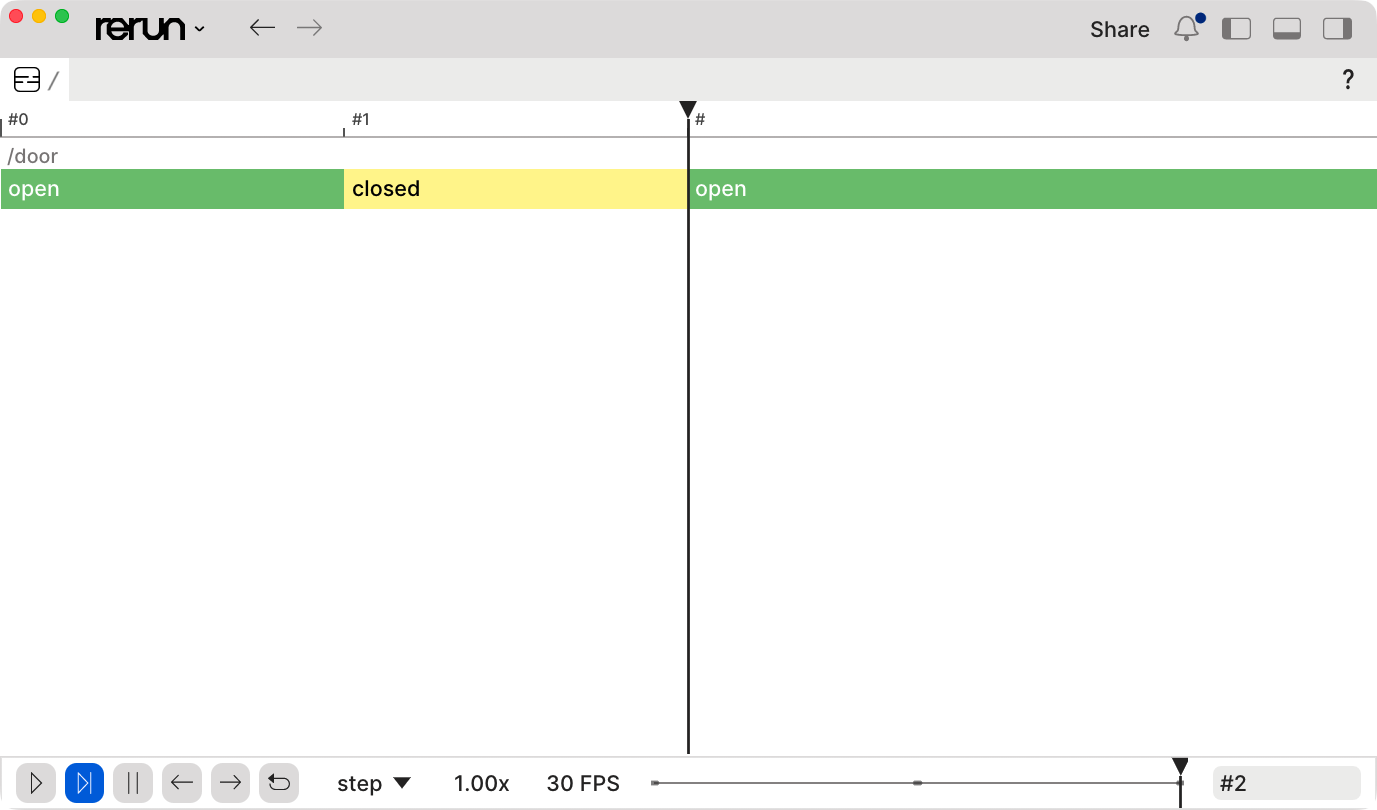
Useful for representing discrete state machines, mode transitions, or state changes over time. Each logged archetypes::StateChange marks a new state at the given time. A null state resets the state, showing a gap in the state timeline view.
The state timeline view displays these as horizontal colored lanes over time.
Example
State changes over time
Member Function Documentation
◆ with_state()
|
inline |
The new state values; each instance gets its own lane in the state timeline view.
A reset ends the previous state and shows a gap in the state timeline view until the next state. An empty string, a null array entry, and an empty state array (e.g. from clearing the field) all act as resets.
The length of the state array should not change over time.
◆ columns() [1/2]
| Collection< ComponentColumn > rerun::archetypes::StateChange::columns | ( | const Collection< uint32_t > & | lengths_ | ) |
Partitions the component data into multiple sub-batches.
Specifically, this transforms the existing ComponentBatch data into ComponentColumns instead, via ComponentBatch::partitioned.
This makes it possible to use RecordingStream::send_columns to send columnar data directly into Rerun.
The specified lengths must sum to the total length of the component batch.
◆ columns() [2/2]
| Collection< ComponentColumn > rerun::archetypes::StateChange::columns | ( | ) |
Partitions the component data into unit-length sub-batches.
This is semantically similar to calling columns with std::vector<uint32_t>(n, 1), where n is automatically guessed.
Member Data Documentation
◆ state
| std::optional<ComponentBatch> rerun::archetypes::StateChange::state |
The new state values; each instance gets its own lane in the state timeline view.
A reset ends the previous state and shows a gap in the state timeline view until the next state. An empty string, a null array entry, and an empty state array (e.g. from clearing the field) all act as resets.
The length of the state array should not change over time.
◆ Descriptor_state
|
staticconstexpr |
ComponentDescriptor for the state field.
The documentation for this struct was generated from the following file:
- rerun/archetypes/state_change.hpp